

Reviewed by Santiago Arroyave, Legal and Commercial at Nexo Legal.
Quick answer (nearshoring Colombia 2026): Most nearshoring content about Colombia in 2026 leads with a single argument: U.S. immigration costs are pushing companies out. That story is weaker than it sounds right now — the USD 100,000 H-1B fee that drove it was struck down in federal court in June 2026, the government’s appeal was rejected in July, and when the administration extended the fee in September 2026, a second federal court blocked it again on September 30. The more durable case for nearshoring to Colombia has little to do with what’s happening in Washington. It’s about what’s happening here: Colombia climbed into the top tier of Kearney’s 2025 FDI Confidence Index, the wider outsourcing industry is shifting toward hybrid sourcing models that favor real-time, nearby delivery, and Medellín was named 2026 City of the Year in StartupBlink’s global innovation business environment ranking. None of that requires a U.S. policy crisis to matter — and none of it is what the BPO and staffing firms competing for your attention are telling you about the legal side of setting up here.
Table of Contents
- Why This Isn’t Another “Companies Are Fleeing the US” Article
- Pull Factor 1: Colombia’s Rising FDI Confidence
- Pull Factor 2: The Industry Is Moving Toward Hybrid Sourcing — And Colombia Fits It
- Pull Factor 3: Medellín’s Innovation Ecosystem Is Institutional, Not Just Marketing
- Pull Factor 4: Trade Access and Cost Stability Versus Mexico
- What Every BPO Pitch Leaves Out: The Legal Establishment Question
- Nearshoring Colombia Setup: SAS, Branch, or Free Trade Zone
- Common Mistakes Companies Make When They Skip the Legal Step
- Talk to a Legal Team Before You Sign a Services Contract
- FAQ
Why This Isn’t Another “Companies Are Fleeing the US” Article
If you’ve researched nearshoring to Colombia recently, you’ve probably read a version of this narrative: U.S. work visas became too expensive and unpredictable, so companies are moving technical and back-office roles to Colombia instead. That story isn’t wrong — we covered it in detail in our guide to the H-1B changes and Colombia nearshoring — but as of this writing it’s a weaker argument than it was even six months ago.
In September 2025, a presidential proclamation imposed a USD 100,000 fee on new H-1B petitions. On June 8, 2026, the U.S. District Court for the District of Massachusetts vacated that fee entirely, ruling it was effectively an unauthorized tax rather than a valid immigration measure. The government appealed, and on July 24, 2026, the U.S. Court of Appeals for the First Circuit denied the government’s request to reinstate the fee while the appeal proceeds. The underlying lawsuit is still working its way through the courts, and a future ruling could theoretically revive some version of the fee — but right now, the single biggest “push factor” cited in most 2025-era nearshoring content simply isn’t in effect.
The back-and-forth continued in September. On September 18, 2026, Proclamation 11069 extended the fee through September 21, 2027, without substantively changing it. Twelve days later, on September 30, 2026, the U.S. District Court for the Northern District of California (Global Nurse Force v. Trump) vacated the agency policies used to collect the fee and barred federal agencies from enforcing it until they complete notice-and-comment rulemaking. The government is expected to appeal to the Ninth Circuit. In other words: as of early October 2026 the fee is not being enforced, but the issue is far from settled — which is exactly why it makes a poor foundation for a multi-year location decision.
That’s exactly why this article focuses on something different: the reasons Colombia is attracting investment and delivery operations independent of U.S. immigration volatility. Those reasons are more durable, because they don’t depend on what a U.S. court decides next.

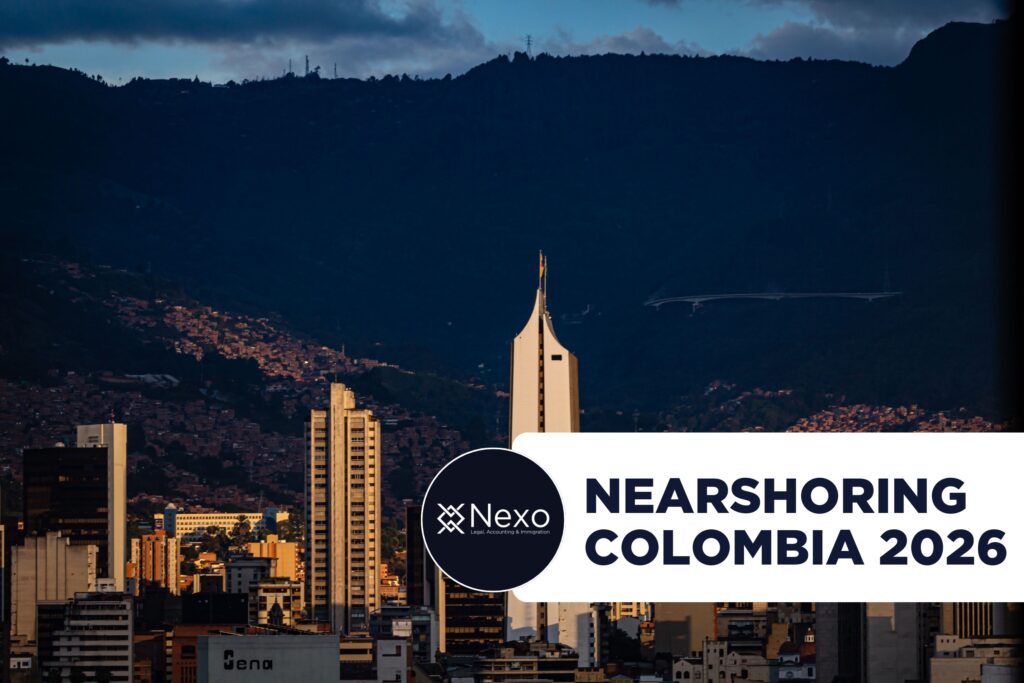
Nearshoring Colombia decisions increasingly point to Medellín’s ecosystem.
Pull Factor 1: Colombia’s Rising FDI Confidence
Kearney’s Foreign Direct Investment Confidence Index — one of the most closely watched signals of where global executives plan to put capital — placed Colombia at #20 in its 2025 ranking, a notable result in a year the report itself characterized as one of broad “inflection” and caution among investors globally. Getting a Latin American economy into the top 20 of a ranking dominated by the U.S., major European economies, and fast-growing Gulf and Asian markets is not a routine outcome — most years, the region is thin on that list.
What matters for a company evaluating where to put a delivery center, a shared services hub, or a regional headquarters isn’t the ranking number itself — it’s what it signals: institutional investors and multinational executives are, on balance, more confident about deploying capital into Colombia than into most of its regional peers. That confidence shows up downstream in easier access to local financing, a deeper pool of firms with experience serving foreign clients, and a regulatory environment that — while it has real complexity, covered below — is not treated by the market as a high-risk outlier.

Hybrid sourcing models favor teams in the same time zone as the client.
Pull Factor 2: The Industry Is Moving Toward Hybrid Sourcing — And Colombia Fits It
The outsourcing and global business services industry itself is changing in a way that favors markets like Colombia. Research from Tholons projects that roughly half of enterprises will run hybrid sourcing models by the end of 2026 — keeping high-volume, less time-sensitive work in traditional offshore hubs while moving complex, communication-heavy, or time-sensitive functions to nearshore partners where real-time collaboration is actually possible.
This shift is driven less by cost than it used to be. Industry surveys now show that access to talent, not cost-cutting, has become the leading reason companies outsource at all — a reversal from just a few years ago, when cost reduction dominated the decision. That change favors Colombia specifically: it offers real-time or near-real-time overlap with U.S. business hours, a growing bilingual technical workforce, and cultural familiarity with U.S. business norms that pure low-cost, high-time-difference destinations can’t match. Companies aren’t choosing Colombia because it’s the cheapest option on a spreadsheet — they’re choosing it because it fits a hybrid model where speed of collaboration matters as much as the hourly rate.
Pull Factor 3: Medellín’s Innovation Ecosystem Is Institutional, Not Just Marketing
Medellín’s reputation as an innovation hub isn’t new, but 2026 brought a concrete, current data point: the city was named City of the Year in StartupBlink’s 2026 Innovators Business Environment Index, a global benchmark built specifically to evaluate how easily innovators and founders can start and operate a business in a given city. The recognition came out of coordinated work between Ruta N (the city’s public innovation agency), the Medellín mayor’s office, the Centro para la Cuarta Revolución Industrial, and Georgia Tech’s Center for Entrepreneurship and Innovation — not a marketing campaign, but an institutional track record.
That track record shows up in other independent rankings too: Medellín climbed into the top 130 cities in StartupBlink’s broader Global Startup Ecosystem Index in 2026, jumping 15 positions from the prior year and moving ahead of cities like Rome, Rio de Janeiro, Monterrey, and Abu Dhabi. On startup density specifically, Medellín now leads every major Latin American capital — including Bogotá, Santiago, São Paulo, and Buenos Aires — with close to 11 startups per 100,000 residents.
For a company evaluating whether Medellín is a real innovation ecosystem or just a well-marketed one, the honest answer is: it’s institutional. Ruta N and iNNpulsa Colombia actively fund and support technology ventures and digital transformation projects, and the national government’s digital strategy for 2026–2030 — set by MinTIC — names applied artificial intelligence, cybersecurity, and exportable digital services as core national priorities. The specific dollar figures attached to individual AI funding lines vary by program and aren’t consistently published in one place, so we’re not going to cite a single number here that we can’t stand behind — but the institutional commitment across Ruta N, iNNpulsa, and MinTIC’s national digital roadmap is real and verifiable, and it’s part of why the ecosystem keeps attracting founders and delivery centers rather than just tourists.

Choosing between an SAS, a branch or a free trade zone is a legal decision first.
Pull Factor 4: Trade Access and Cost Stability Versus Mexico
Colombia currently maintains 18 active trade agreements, giving companies operating here preferential access to more than 1.5 billion consumers across markets that include the United States, the European Union, Canada, Mexico, Chile, South Korea, and the Pacific Alliance bloc. For a company using Colombia as a services or light-manufacturing base rather than purely a domestic-market play, that network of agreements matters as much as the local talent pool — it determines what else the operation can reach from here.
The comparison companies actually run internally, though, is usually Colombia versus Mexico — the other dominant nearshoring destination in the hemisphere. Mexico offers proximity to the U.S. border and an established manufacturing base that Colombia doesn’t try to compete with directly. But Mexico’s nearshoring boom has also driven up real estate, industrial land, and skilled-labor costs in its most popular corridors faster than in Colombia’s comparable cities, and Mexico’s own trade relationship with the U.S. carries its own separate set of tariff and policy exposures under USMCA review cycles. Colombia’s pitch isn’t “cheaper than Mexico across the board” — costs vary by sector and city — it’s more predictable: a services- and talent-driven nearshoring case that isn’t riding on the same border-manufacturing dynamics currently pushing up costs and drawing political scrutiny in Mexico’s top nearshoring hubs.
What Every BPO Pitch Leaves Out: The Legal Establishment Question
Search “nearshoring Colombia” and most of what comes back is staffing and BPO providers — firms like the ones dominating this space — selling their own delivery capacity: seats, agents, developers, a monthly per-head rate. That’s a legitimate model for a lot of use cases, and it’s genuinely faster to start than building your own operation.
What that content almost never covers is the question that matters most before you sign anything: are you actually setting up a compliant legal presence in Colombia, or are you renting headcount from someone else’s entity while assuming risks you haven’t evaluated? A BPO or staffing vendor’s sales team is not positioned — and usually not qualified — to walk you through Colombian corporate structuring, tax registration, or labor compliance, because doing so isn’t their business. Their business is filling seats.
That gap is the real opportunity for companies serious about a Colombian presence, not a vendor relationship: understanding the legal paths to actually establishing operations here, so the nearshoring decision is a durable business structure rather than a services contract you renew every year at whatever rate the vendor sets next. If you’re weighing that decision, our guide to doing business in Colombia in 2026 covers the full setup sequence, and if you plan to export to the U.S. from here, check the current status of US tariffs on Colombian exports before you model costs.

A compliant legal presence protects the operation beyond the first services contract.
Nearshoring Colombia Setup: SAS, Branch, or Free Trade Zone
Companies establishing a legal footprint in Colombia generally choose between three structures, and the right one depends on how the operation will actually run — not on which option a sales rep recommends.
Sociedad por Acciones Simplificada (SAS). Colombia’s simplified stock company is the most common vehicle for a genuinely independent local operation — a company that will hire directly, hold its own contracts, and build its own commercial track record in Colombia rather than operating as an extension of the parent. It offers flexible governance and limited liability, and it’s the structure most nearshoring operations end up choosing once they move past a pure staffing arrangement.
Branch of a foreign company (sucursal). A branch keeps the Colombian operation legally tied to the parent entity rather than creating a separate Colombian legal person. This can simplify certain reporting and consolidation questions for the parent, but it also means the parent’s liability isn’t ring-fenced from the Colombian operation the way it would be with a SAS — a tradeoff worth running past counsel rather than defaulting to whichever structure a template recommends.
Free Trade Zone registration. Independent of which entity type you choose, operations exporting services — technology development, back-office and financial processing, legal and compliance support — can evaluate Free Trade Zone status for meaningful tax benefits, including a reduced corporate rate and exemptions on qualifying imports. It’s not mandatory, and it adds its own compliance layer, but for service-export operations at real scale it’s usually worth the evaluation.
None of these three paths is inherently “correct” — the right choice depends on hiring plans, whether the operation needs its own contracting authority in Colombia, and how the parent company wants liability and tax exposure structured. That evaluation is exactly the conversation a staffing vendor’s sales process skips.
Common Mistakes Companies Make When They Skip the Legal Step
- Treating a staffing contract as a substitute for a legal presence. Renting headcount through a BPO is not the same as establishing compliant Colombian operations, and the two carry very different risk profiles if the relationship or the regulatory environment around it changes.
- Assuming Free Trade Zone benefits apply automatically. They don’t — the status has to be evaluated and formally requested, and not every business model qualifies for the same benefits.
- Underestimating labor compliance from day one. Colombia’s labor framework — electronic payroll registration, statutory benefits, and (for anyone hiring rather than contracting) direct employment obligations — applies regardless of whether the parent company is used to a lighter-touch jurisdiction.
- Picking a structure based on speed alone. A staffing arrangement is faster to start than a SAS, but “faster” isn’t the same as “right for a two-year commitment” — the cost of restructuring later is almost always higher than the cost of getting proper legal advice before the first hire.
- Ignoring data protection obligations. Colombia’s data protection law (Ley 1581 de 2012) applies to operations handling personal data for U.S. or other foreign clients, and it’s routinely missed by companies focused only on the commercial side of a nearshoring deal.
Talk to a Legal Team Before You Sign a Services Contract
If you’re evaluating Colombia as a nearshoring destination, the highest-leverage conversation you can have isn’t with a BPO sales team — it’s with legal counsel who can walk through which structure actually fits your operation before you commit to one. Our softlanding and market-entry team works specifically with foreign companies setting up legal, tax, and labor-compliant operations in Colombia, covering entity selection (SAS versus branch), Free Trade Zone evaluation, tax registration, and the labor compliance framework you’ll need from your first local hire onward.
That conversation typically resolves three questions most companies haven’t answered before they start talking to vendors: whether a SAS or a branch actually fits the operation you’re planning; whether Free Trade Zone status is worth pursuing given your export profile; and what your real compliance timeline looks like before you can legally hire, invoice, or hold contracts in Colombia. Getting those answers before you sign a staffing agreement is considerably cheaper than restructuring a year in.
FAQ
Is nearshoring to Colombia still worth it now that the H-1B $100,000 fee was struck down?
Yes — the fee’s legal status was never the strongest argument for nearshoring to Colombia in the first place. Colombia’s case rests on its own FDI momentum, its innovation ecosystem in cities like Medellín, and the broader industry shift toward hybrid sourcing models, none of which depend on U.S. visa policy.
What’s the difference between nearshoring to Colombia through a BPO and setting up my own legal entity?
A BPO or staffing arrangement rents you headcount under someone else’s Colombian entity — faster to start, but you don’t control the legal structure, and you’re exposed to whatever terms the vendor sets. Setting up your own entity (typically a SAS) gives you direct control over hiring, contracts, and compliance, at the cost of a longer setup process.
Do I need a Free Trade Zone registration to nearshore services to Colombia?
No, it’s not mandatory. It’s an optional status worth evaluating for service-export operations at scale, since it can reduce corporate tax exposure and exempt certain imports — but plenty of nearshoring operations run without it.
Is Colombia cheaper than Mexico for nearshoring?
Not uniformly — costs vary by sector and city in both countries. Colombia’s advantage isn’t a blanket cost discount; it’s more predictable cost growth and a services-and-talent-driven case that isn’t tied to the same border-manufacturing real estate pressure currently pushing up costs in Mexico’s top nearshoring corridors.
What legal structure should a US company use to hire employees directly in Colombia?
Most companies planning to hire directly, rather than contract through a vendor, use a SAS (Sociedad por Acciones Simplificada) for its liability protection and governance flexibility. A branch is a valid alternative when the parent company wants the Colombian operation to remain formally part of the same legal entity, but it doesn’t separate liability the way a SAS does.
Does Colombia’s trade agreement network matter for a nearshoring operation, or only for exporters of physical goods?
It matters for services too — the market access those 18 agreements provide affects clients, banking relationships, and future expansion plans even for a purely services-based nearshoring operation, not just companies shipping physical products.
Published: September 2026 — Nexo Legal
Sources: Federal Court Vacates $100K H-1B Fee Policies in Global Nurse Force v. Trump — Immigration Analytics, Oct. 1, 2026 | Court Strikes Down $100,000 H-1B Entry Fee — Vorys | First Circuit Blocks Reinstatement of $100K H-1B Fee — Clark Hill | The 2025 Kearney FDI Confidence Index | Tholons 2025 Top 10 GCC/GBS Trends, cited via Auxis | StartupBlink Innovators Business Environment Index 2026 | Medellín and Bogotá Startup Density 2026 — Rio Times | Colombia Trade Agreements — Procolombia | Ley 1581 de 2012